Price Building
In this lesson, you will learn the essentials of crafting a product price policy, emphasizing the crucial interplay between value and pricing in the business model. The categories of result-oriented and information-based products are explored, along with insights into balancing expenses and income. Practical guidance is provided for strategic price building, and a concise example illustrates dynamic pricing based on time investment. The lesson equips you with key principles for effective pricing in their entrepreneurial ventures.
How to Develop a Product Price Policy
Now that we have our products mapped and listed, let’s delve into pricing questions. Pricing holds paramount importance in the business model because it influences the customer’s decision on whether to use your products or services. Of course, value comes first, and price follows.
When considering employing someone or using services, I typically review their works and seek testimonials to gauge the quality of service. After establishing value, I then examine the price to assess its adequacy relative to the service provided. This underscores the importance of not arbitrarily setting prices but rather basing them on the value and the expenses incurred to provide that value.
The Value of Your Product
The value of your product is directly tied to the final outcome, or point B—how fast, easy, or efficiently the customer reaches point B with your products. This value is result-oriented.
Result-Oriented Products:
Some products guide customers directly from Point A to Point B, emphasizing practical steps, detailed instructions, feedback, an accountability system, and motivation. Examples include:
- Individual Coaching Program
- Group Coaching Program
- Course Led By Instructor
Information-Based Products:
Other products lead customers from Point A to Point B with detailed instructions only, lacking feedback and accountability. Examples include:
- Course On Demand
- Non-Fiction Book
- Workbook
Products not mentioned in the above categories are elements that can be bought separately but don’t guide the customer through a specific process. All services include elements found in coaching and courses.
Expenses: Value Production and Delivery Expenses
Everything you do or produce comes at a cost, even when offered for free. Your lifetime is your greatest asset, and utilizing it is the most expensive thing. Be cautious about how you use your time; your hour is the most valuable thing on Earth. The most expensive products will be those requiring your personal attention.
Consider the time spent creating products you can now sell repeatedly without immediate attention—the second expense. The third expense includes:
- Your PC Device (purchase, maintenance, and upgrades)
- Programs like video editors and office programs
- Subscriptions to services (e.g., Google Meet, website hosting, plugins)
- Electricity and Internet data
Balancing income to cover expenses and ensuring value costs remain competitive is crucial for business development.
Let’s now build our price:
Price Building
- Assign value to your hour: Acknowledge the worth of your time as a foundational step in pricing strategies.
- Set the price for all your services based on your hourly rate initially: Establish a pricing baseline by determining the hourly rate for your services.
- Price tools affordably, recognizing their value within your system and in conjunction with other products: Ensure that tools associated with your services are reasonably priced, considering their value in the broader context of your offerings.
- Calculate the cost of digital products based on separately priced services: For digital products comprising individually priced services, compute the overall cost accordingly.
- For Coaching Programs and Courses, contemplate providing free access to tools if needed, enabling their costs to be factored into the overall price: Consider offering complimentary access to tools within Coaching Programs and Courses, allowing their costs to be integrated into the overall pricing structure.
Example of Pricing
Here’s an example of the pricing dynamic for different product types that a public figure or influencer might have. It illustrates the lowest and highest prices per product, showcasing how the price changes based on the time invested.
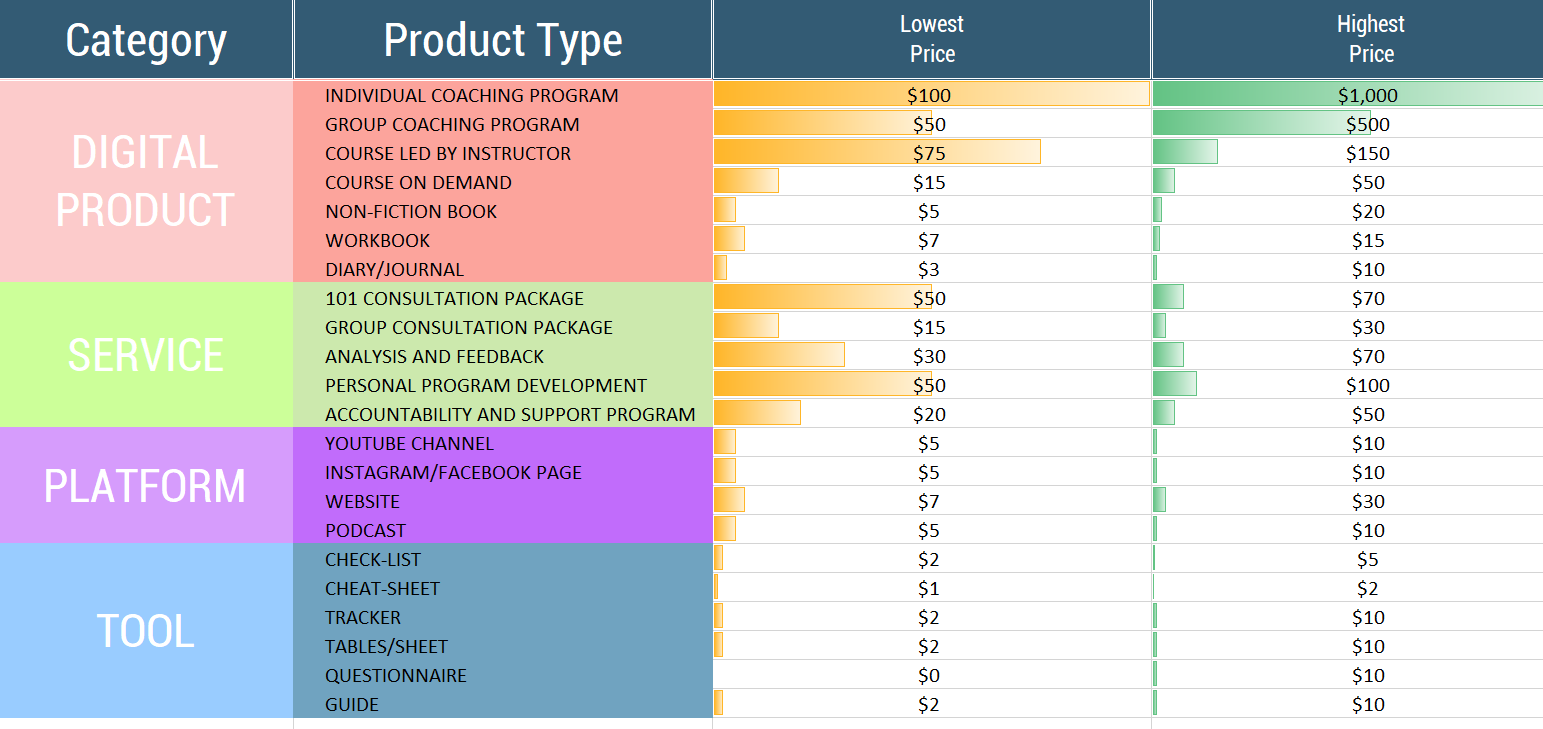
The more time spent, the higher the price, and conversely, the less time spent, the lower the price. Lets say the book requires from you 50 hours of writing, but then you can sell the same book for years and not spend more time, whereas the 101 coaching will require your time every time.